Logistics and 3PL Operators
Which dock door is under the leak, and what is on the racking below it? For a logistics operator in Temple, TX, those two questions come before any question about membranes. Distribution and logistics buildings are a major part of the local stock, including a retail distribution center and a Walmart distribution center that each run about two million square feet by economic-development account, and rail-served buildings sit near the BNSF and Union Pacific mainlines that cross the city. A roof over a warehouse like that is a long, flat surface that depends on a handful of drains, and a failure at one of them can reach goods within hours.
We treat the first hour as a triage problem. The make-safe step keeps water off product. The intake record names the failure point. The permanent scope follows once the moisture survey has drawn the wet area, and the operator keeps the right to decide how much to spend and when. A leak that reaches racking is a different kind of event from a leak over empty slab, and the intake record notes which one it was, with photographs of what sat below the opening at the time.
Where Does a Warehouse Roof Fail First?
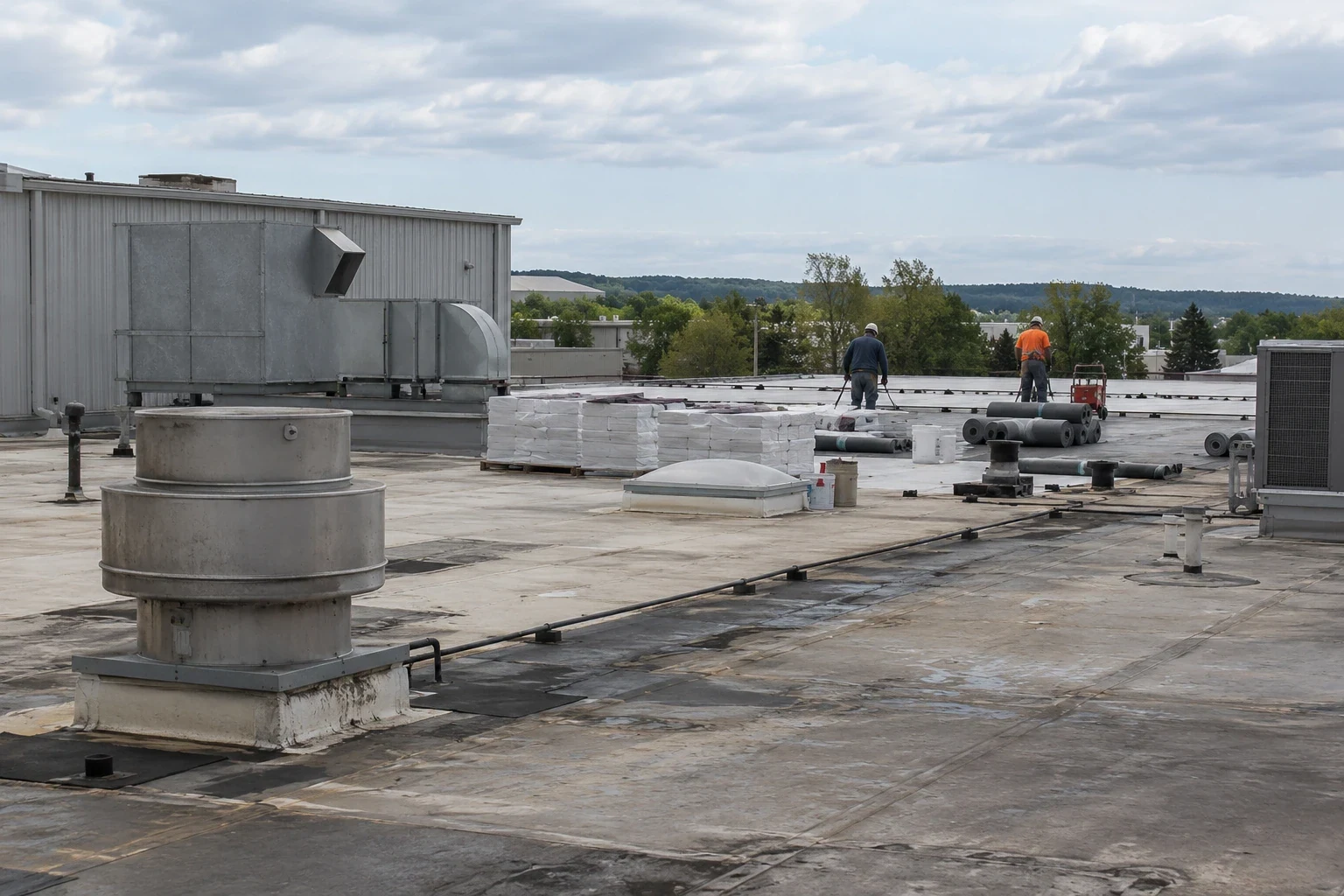
On a long, low-slope roof, the first failures are drains, seams and the joints where the sheet turns up a wall. A blocked drain holds a pond over a seam. A seam under standing water opens along its weakest stretch. A parapet joint that has dried out lets water run behind the flashing and into the wall cavity. We walk the roof in that order, starting at the drains, because a pond tells us where to look next. We measure the depth of any pond, note how long it takes to drain after rain and compare the pattern with the slope lines. A pond at the same place after every storm points to a low spot or a high drain, and a pond that moves from storm to storm points to blocked outlets or debris.
Penetrations come after the field. Roof hatches, vents, smoke vents and rooftop units each carry a flashing, and each flashing ages at its own rate. Large buildings also carry fire-protection piping and conduit across the roof, and the supports for those lines can wear through the sheet over time. The inspection records every support and flags the ones that rest directly on the membrane.
Rooftop units on large warehouses are often heating and ventilation equipment for office areas, dock offices or cold storage. Each unit sits on a curb, and each curb is flashed to the sheet. When a unit has been replaced, the new curb may not match the old one, and the flashing may have been rebuilt by a trade that does not roof. We photograph those curbs close up and note any gap between the curb and the sheet.
How Do Repairs Work Around Dock Schedules?
A dock schedule is a fixed rhythm: trucks arrive in waves, pallets move in and out, and a delay at one door ripples to the next. Roofing near docks has to respect that rhythm. We schedule material deliveries away from peak truck times, keep crane picks out of the apron and place dumpsters where a tractor trailer can still turn. Sections of roof above active docks are dried in first and worked in the quietest hours.
Inside, we ask the operator to move product away from the area below the work or to cover it. If product cannot be moved, we install interior protection before the first panel comes off. The plan names a contact for the dock supervisor and a call-back window for questions during the shift.
Noise is part of the plan too. Dock offices and break rooms sit close to the roof edge on many buildings, and a nail gun or a power cutter right above them is a quality-of-work issue for the people inside. We schedule loud work for the start or end of a shift, give the supervisor a warning before it begins and stop if someone raises a safety concern.
What Do Interstate 35 and the Rail Lines Mean for Roofs?
Interstate 35 runs directly through Temple, Loop 363 circles the city for 17.1 miles, and Union Pacific and BNSF mainlines pass through. Those corridors shape how trucks and freight reach logistics buildings, and they also bring dust, vibration and exhaust film that settle on roofs. Surfaces near heavy truck routes lose reflectivity faster and collect debris in drains. Our maintenance calendar includes surface cleaning and drain clearing at intervals that match the exposure, and the intervals shorten after construction nearby, since dust from new work collects in the same drains.
For buildings near the Rail Park at Central Pointe and the Airport Park at Central Pointe, the same record format applies, and the haul route is drawn once for the whole project.
Which Weather Events Should a Logistics Plan Cover?
With August highs near 95 F and about 80 days a year over 90 F, a metal-deck warehouse heats from within and the membrane bakes from above. Heavy rain, about 39 inches a year, tests drains. The May 22, 2024 tornado was an EF-2 with peak winds near 120 mph, and the weather service estimated 80 to 90 mph straight-line winds across Temple that day. A warehouse owner uses these facts to decide how often to check edges, curbs and drains, and what to keep in reserve for emergency work. Straight-line wind lifts edges first, so the first inspection after such an event starts at the perimeter and the corners, then moves to equipment curbs and then to the field. A tornado damage repair estimate begins from the same walk.
How Do You Rank Many Buildings by Exposure?
Operators with several buildings need a ranking by consequence of failure. A building full of high-value goods ranks above a building holding slow-moving stock. A roof with open seams ranks above one with sound seams. The ranking becomes a calendar: which roof gets attention this quarter, which gets a coating next year and which only needs a drain check. A multi-site roof program turns that ranking into a schedule and a budget.
The same ranking works for a plant owned by one of the manufacturers in town and for a portfolio held by investors and REITs.
What Does the Permanent Scope Look Like?
The permanent scope for a warehouse roof states the system, the insulation, the cover board, the flashing at every penetration, the edge metal and the drains. It also names the phases, so the operator can see which dock doors are affected on which weeks. A distribution center roof is usually done in bays that can be dried in daily. Cost moves with area, penetrations, deck condition and access, and the scope lists each so the operator can see what drives the number. Where a roof has seen several repairs, the scope also says which of them will be removed and which will be left in place, so no one is surprised by what is under the old sheet.
Commercial Roofing Questions
Can warehouse roofing continue during peak season?
Yes, with sections sized to be dried in daily and deliveries scheduled away from truck waves. Some operators prefer to postpone large replacements until after peak, and a holding repair carries the roof through the gap, with a dated plan for the permanent work.
What do you need to know before dispatching a crew?
The building address, which dock or bay is affected, what is stored below and who can authorize emergency work. With that, a crew arrives prepared.
How is product protected during tear-off?
By moving it where possible and by installing interior protection where it cannot be moved. The dock supervisor receives a daily plan.
Is a coating a good option for a large warehouse roof?
A sound membrane over dry insulation makes a coating a fair option. A moisture survey confirms both conditions, and the coating is priced next to a replacement for a full comparison.
Who keeps the record of a roof incident?
We keep the intake record and give the operator a copy for the file, formatted so it can go to an insurer or a landlord.