Infrared Roof Moisture Survey
Wet insulation is the quiet cost in a flat roof. It adds weight, kills the thermal value of the insulation, corrodes the deck and feeds the next leak, and none of it shows on the surface. A moisture survey exists to find it. An owner in Temple, TX who commissions one before a repair or replacement decision can spend less on the work, because the scope is drawn around what is really wet instead of what is assumed.
The survey combines two methods. Infrared scanning finds the places where the roof behaves differently after sunset, which is a sign of trapped water. Core cuts confirm what the scan suggests by exposing the layers and measuring the moisture directly. Together they turn a vague worry into a map with edges, and the map is what a decision can stand on.
How does infrared scanning work?
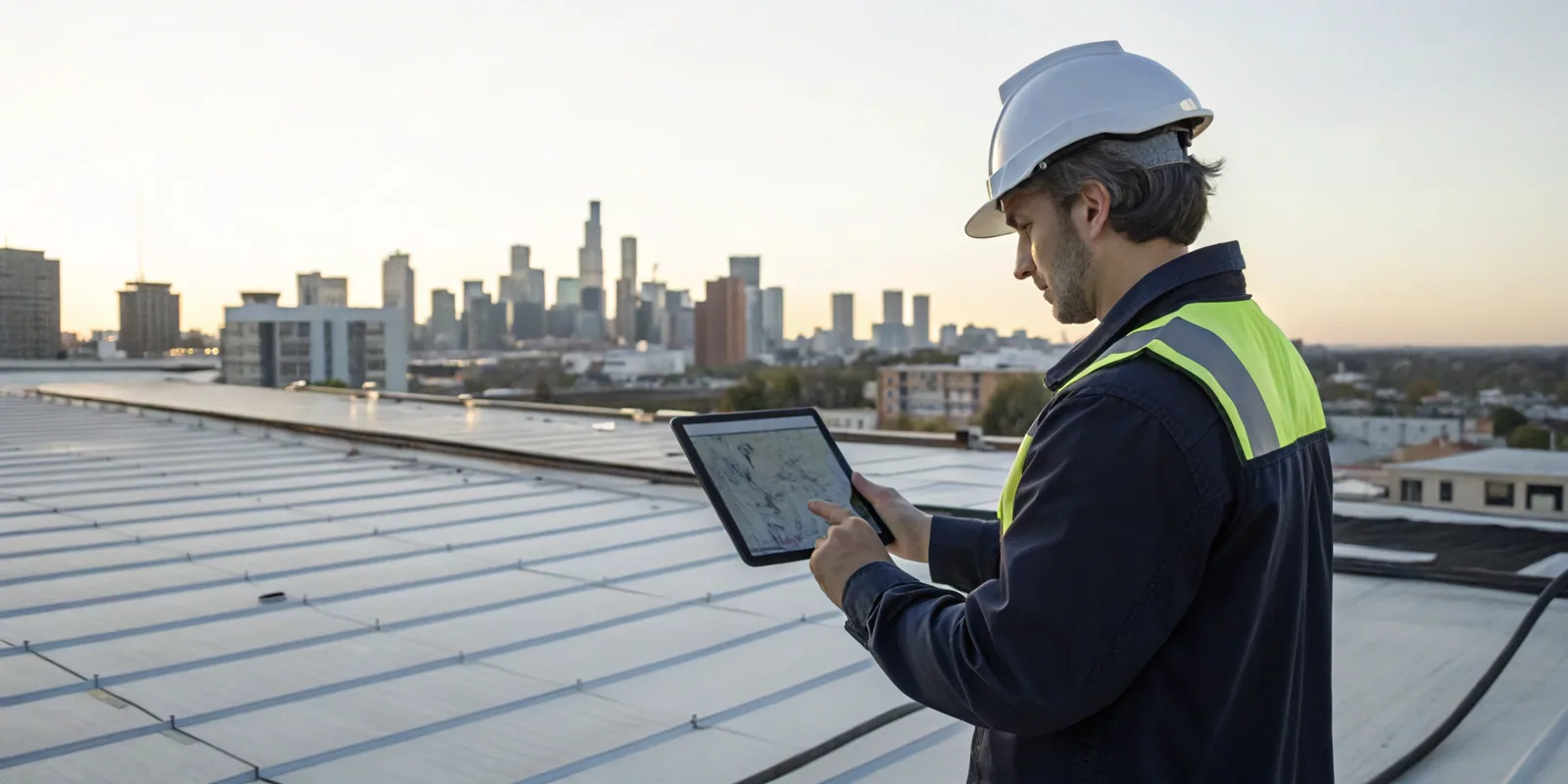
Wet insulation holds heat longer than dry insulation. During the day the roof absorbs solar energy; after sunset the dry areas cool quickly while the wet areas stay warmer. A thermal camera, walked across the roof or flown above it, picks up that difference as a pattern of warm patches. Scanning runs on clear, calm evenings when the roof has had a full day of sun and the surface is dry.
Temple's long hot season helps. With 95F August afternoons and some 80 days a year past 90F, the roof stores plenty of heat to release, which makes the contrast clearer. We still read the patterns with care, since equipment, ballast, patches and shaded areas can create warm spots that are not moisture. That is the reason the scan is never the final word.
Why are core cuts part of the survey?
A scan shows where something is different. A core cut shows what. We remove a small circular sample at selected spots, inspect the layers, measure the moisture in the insulation and note its condition, then seal the opening with a durable patch. Cores answer the questions the scan cannot: how many layers are there, what type of insulation, is it wet, is the deck sound?
We place cores across the range of conditions: some in warm areas to confirm water, some in cool areas to confirm dry material and some at doubtful spots. This sampling proves the boundaries of the wet zone, and the boundary is what a repair scope needs. The cores also tell us whether a recover is possible, since a recover requires dry insulation and a sound deck.
What does the owner receive?
A roof plan with the wet areas outlined, the core locations marked and the thermal images alongside ordinary photographs. A table of core findings, including layer makeup and moisture readings. And a recommendation that sorts the roof into three groups: areas that can stay, areas that need cut-out and replacement, and areas where the whole assembly is compromised.
For a single roof, that is a scope you can price. For several roofs, the same format lets you compare them: percentage wet, number of layers, age, deck condition. The format fits a roof condition report and drives the order in which roofs are replaced. The comparison can change the order of the work, because the roof that drew the most complaints is not always the one with the most trapped water, and a quiet roof can be hiding the biggest problem on the portfolio list.
When is a survey worth doing?
Before a major repair, to avoid fixing what is not broken. Before a recover, because it is a requirement. Before buying a building, as part of due diligence. After a leak that has no obvious source. After a storm, when water may have entered through openings that closed again. And on older roofs where the insulation has been wet-and-dry cycled for years.
A warehouse owner in the Temple Industrial Park with a large roof field and a single leak complaint can use a survey to learn whether the leak is local or part of a wider pattern, and the answer decides between a small leak repair and a bigger program. The owner of a warehouse roof often gets the most from the map because the field is large and a partial cut-out can save the rest. An investor evaluating a purchase near Downtown Temple can use one to price the roof accurately before closing.
What can stop a survey from working?
Ballasted roofs, heavy gravel surfacing and thick reflective coatings can mask thermal differences. Fresh rain leaves the surface wet and confuses readings. Dense cloud or wind can reduce contrast. When conditions are poor, we reschedule instead of reporting an unreliable result, because a bad scan does more harm than none.
On a roof where infrared is not suitable, we can use other tools, such as capacitance meters or nuclear gauges where available, along with a denser core pattern. The aim is the same: a defensible map of moisture. We state in the report which methods were used and what limits applied, so the reader knows how far to trust it.
The survey also respects the occupants. Scanning happens in the evening, usually without entering the building, and coring is quick and quiet compared with repair work. Tenants rarely notice either, and the property manager gets the results before any contract is signed for repair or replacement. If the results show a problem larger than expected, there is time to plan funding rather than react.
How do storms change the survey?
Wind-driven damage can open the roof briefly and let water in without leaving a leak. After the May 22, 2024 tornado and the 80 to 90 mph straight-line winds the National Weather Service estimated across Temple, a survey of a damaged building can show how far water traveled before the opening was closed. That information supports the repair scope and the documentation behind a claim. Surveying soon after the event matters, because wet insulation that dries partly over a few weeks becomes harder to map and easier to argue about.
Commercial Roofing Questions
How long does a survey take?
A typical roof can be scanned in an evening and cored the next day. Larger buildings take longer. The report follows once the field data has been reviewed, and urgent findings are called in as soon as they are confirmed. We agree on the evening scan window and the core locations with the building contact in advance, so access to the roof and any restricted areas is settled before the first reading.
Does coring damage the roof?
Each core is a small opening that we patch with materials compatible with the roof. A proper patch is as watertight as the surrounding membrane. We keep the number of cores to what the findings require.
Can a survey find a specific leak?
It can narrow the search by showing where water has collected, and the wet area often leads back to the entry point. Pinpointing the exact opening may still need a walk and sometimes a water test.
How often should a roof be surveyed?
The interval depends on age, condition and criticality. Older roofs and those with a history of leaks justify more frequent checks; newer roofs may only need a baseline and a follow-up after a major event.
What happens if the survey shows the whole roof is wet?
The membrane and insulation have reached the end of useful life, and replacement is the right decision. The survey gives a clean basis for the replacement scope and helps justify the capital request.